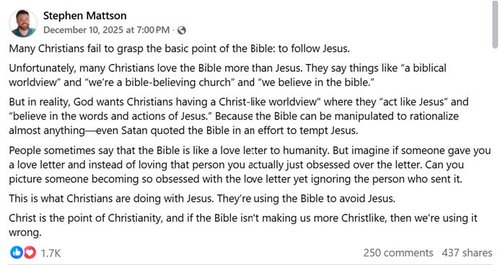
Recently I was made aware of a Facebook post by Stephen Mattson, an author and activist currently working for Northwestern St. Paul. His sentiment echoes (or is being echoed by) many in our online and in-person friends who are attempting to dispense with biblically sourced truth in favor of a shapeless, highly subjective “alignment” with the person of Christ. Here is the post:
First, where do we agree?
It is true that the most basic point of the Bible is to follow Jesus. Jesus Himself demonstrated that what was written in the Old Testament concerned Him, and from it showed that He should suffer, be raised from the dead, and that the Gospel should be proclaimed throughout the world (cf. Luke 24.44-47). John’s gospel was written with the intention that its readers should believe, and in so doing “may have life in His name” (John 20.31). God does want Christians to have a Christ-like worldview, to act like Jesus, and to believe Jesus’ words. In the evangelistic sense we’re to see like Jesus that the “fields are white for harvest” (John 4.35), and we are called to join Paul as he imitated Christ (1 Cor. 11.1). We also agree that the Bible has been manipulated for nefarious ends, such as Satan’s quotation of Psalm 91.11-12 (Matt. 4.6) and the twisting of Paul’s words by the ignorant and unstable “to their own destruction” (2 Peter 3.16).
However, agreement soon grows scarce, for this author draws the line of true Christianity between those who believe/ follow what the Bible says, and those who “follow Jesus”.
Sculpting Jesus In Our Own Image
The issue here is the author (and others like him) have “grown” so much in their "understanding” of Jesus that they now claim the ability to know whether one’s use of scripture has led one closer to, or further from, what Christ intended. This is seen in the final warning, that if our use of the Bible “isn’t making us more Christlike”, we’re using it wrong. Who exactly is qualified to say whether one’s use of the Bible is making them more or less Christlike? How exactly are we to make such a judgment? To which authority can we turn to know whether one’s Christianty is more or less Christlike? It seems the only Christianity which is condemned is that which is biblically instead of culturally/socially based!
When one’s religious pursuasion permits the notion of God’s revelation directly to the heart, when one’s feelings are trusted as proddings of the Holy Spirit, and when one’s culturally-constructed caricature of Jesus is used to promote popular doctrine, it is easy to see how quickly one can lay aside the scriptures in favor of one’s personal opinion concerning Jesus, and judge those who hold to the scriptures accordingly. This is the highest and most developed form of the subjective anthem “What Would Jesus Do?”, and it’s not the first time we’ve seen it expressed.
In his book, Searching for the Pattern, John Mark Hicks outlines how his “gut”, or his “theological intuition grounded in my formation by the story of God” led him to the conclusion that the scripture’s teaching concerning limitations on congregational benevolence to its members was wrong. Hicks consistently appeals to “the narrative of scripture” as an authority high enough to set aside patternistic, “blueprint theology”, as he calls it. This is but an earlier iteration of Mattson’s error: Setting aside what the Bible actually says in favor of one’s experientially-skewed opinion of what God and Jesus Christ want from us. Paul warned his fellow Christians against those who would not “endure sound teaching” and would instead turn elsewhere to “suit their own passions” (2 Tim. 4.3).
Is Love for the Bible the Problem?
While we readily admit that some use the Bible in ways that avoid the fulfillment of God’s will (like the Pharisees), this post demeans those who are faithfully following God’s word as being obsessed with the text and failing to care about the Author.
Apparently, Mattson either hasn’t read (or remembered) Psalm 119:
- “for I find my delight in your commandments, which I love. I will lift up my hands towards your commandments, which I love, and I will meditate on your statutes.” (vv.47-48)
- “O how I love your law! It is my meditation all the day.” (vv.97)
- “I hate the double-minded, but I love your law.” (vv.113)
- “Therefore I love your commandments above gold, above fine gold.” (vv.127)
- “Consider how I love your precepts! Give me life according to your steadfast love. The sum of your word is truth, and every one of your righteous rules endures forever.” (vv.159-160)
- “I hate and abhor falsehood, but I love your law.” (vv.163)
- “My soul keeps your testimonies; I love them exceedingly.” (vv.167)
Someone better warn the psalmist: He’s becoming “so obsessed with the love letter” that he’s in danger of ignoring the Person who sent it!!! OR, maybe, just maybe, the psalmist loves God’s word because he loves God!!
Actually Following Jesus
For those who adore Jesus Christ above all else, His words are regarded as the highest source of authority in their lives, elevating the scriptures above personal opinions, feelings, and conclusions. It was CHRIST who confirmed the veracity of the Old Testament on numerous occasions. It was CHRIST who said His apostles would bear witness concerning Him, bearing witness alongside the Spirit and being guided into “all truth” (John 16.12). It was CHRIST who said so plainly “If you love me, you will keep my commandments.” (John 14.15). It isn’t love for God’s word that is the problem. The problem is many claim the name of “Christian” and don’t love Jesus enough to love and keep His word.
God’s word is where we learn that God wants us to be Christlike, and how to do so. It was in Phil. 2.5 where we were told “Have this mind among yourselves, which is yours in Christ Jesus…” It is in God’s word that we learn to be servants of one another (Mark 10.43-45), to love each other as Jesus loved us (John 13.34-35), and that we are to “put on the Lord Jesus Christ, and make no provision for the flesh” (Rom. 13.14).
The answer to corrupted Christianity isn’t to set aside our Bibles and act the way we’ve imagined Jesus would want us to act. The answer is to actually read our Bibles and from there see Christ, from His word behold His glory, and from His word learn and do what is pleasing to God.
“Sanctify them in the truth; your word is truth.” (John 17.17)

Kyle Sanders
Kyle has been preaching since 2016 in Chiefland, Florida and Clinton, Mississippi before coming to work with the Jamestown church of Christ in 2021. Before preaching, he spent several years as a high school mathematics teacher in Indiana, Kentucky, and Florida. Kyle is a teacher at heart and brings his love of studying and interacting with students into his preaching and teaching efforts. He and his wife, a native Hoosier, have been blessed with five children, two dogs, a full house and zero leftovers.